
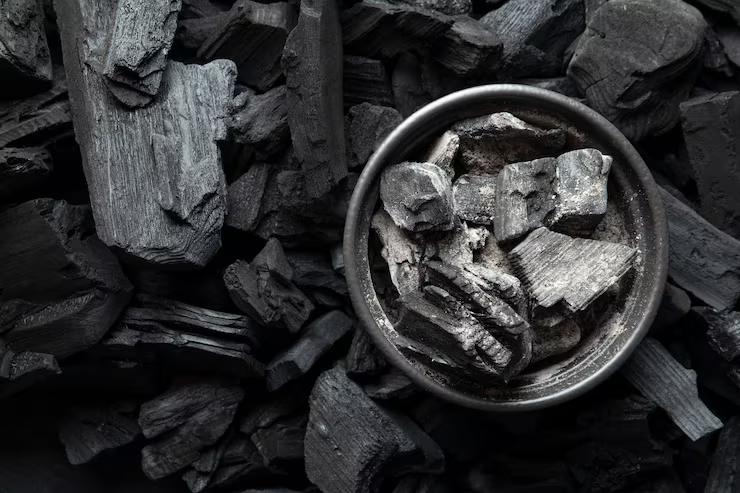
Starting a briquette production business offers a strong opportunity in the renewable energy sector. With rising demand for eco-friendly fuel, understanding how to start a briquette production business—from basic processes to equipment and marketing—becomes essential for success.
This article, themed how to start a briquette production business equipment guide, provides a complete roadmap for beginners who want to enter the industry with jacoid, solid preparation, efficient workflows, and the technical knowledge required to build a sustainable and scalable business.
Choosing the Right Raw Materials
The first step is selecting the appropriate raw materials. Biomass sources such as coconut shells, sawdust, rice husks, straw, and other agricultural waste are the most commonly used options.
-
Coconut shell delivers high calorific value, minimal smoke, and is highly preferred in export markets.
-
Sawdust is widely available, affordable, and ideal for large-scale production.
The quality of the raw material directly affects the strength, density, and burning duration of the briquette. Using clean and dry materials reduces the need for additional processing, lowers production costs, and improves consistency. Choosing materials that are abundant around the production site also ensures long-term supply stability.
Essential Briquette Production Equipment
Within the concept of How to Start a Briquette Production Business Equipment Guide, understanding the core machinery is fundamental. The main equipment includes:
1. Crusher Machine
Used to break raw materials into fine particles so they can be processed uniformly and produce dense briquettes.
2. Dryer Machine
Reduces moisture content to the ideal level of 8–12%. Proper drying prevents cracking, strengthens the final product, and increases market value.
3. Mixer Machine
Mixes raw materials with natural binders such as tapioca. Even mixing is critical to ensure the briquettes are strong and do not crumble easily.
4. Briquette Press Machine
This machine determines the shape and density of the briquettes.
-
Screw press suits high-capacity production and produces very dense briquettes.
-
Hydraulic press delivers precise and stable shapes, ideal for premium markets.
5. Carbonizer (Optional)
Required if producing charcoal briquettes. The carbonizer converts biomass into high-carbon charcoal with excellent burning characteristics.
Supporting Equipment
Supporting tools such as conveyors, sieving machines, blowers, and packaging machines help improve overall efficiency. Conveyors streamline material handling, while sieving machines ensure uniform particle size. Packaging machines help produce professional-looking products that are ready for local or export markets.
Choosing the Right Production Location
The production site should be close to raw material sources, easily accessible, and spacious enough for workflow and equipment layout. Good ventilation is crucial for worker safety and controlling humidity levels. The right location reduces logistics costs, speeds up production, and improves operational efficiency.
Briquette Production Process
The production stages include crushing, drying, mixing, briquetting, secondary drying, and packaging. Quality control must be carried out at each step to ensure the briquettes have high calorific value, good structural strength, and competitive quality. Standardizing the process ensures stable production even as volume increases.
Marketing Strategies
Effective marketing includes offering burn-test samples, educating customers about the benefits of eco-friendly briquettes, and strengthening branding through packaging and business identity. Business owners can also collaborate with restaurants, food factories, hotels, and alternative fuel distributors. Strengthening online presence through websites, marketplaces, and social media is equally important to attract new customers.
Conclusion
Through this How to Start a Briquette Production Business Equipment Guide, entrepreneurs can understand the essential steps in building a briquette business—from raw materials to marketing. With the right equipment, efficient production processes, and targeted sales strategies, this business can generate significant profits while supporting the transition to clean energy.
In the context of global energy transition, briquettes are becoming sustainable briquette alternatives to coal—safer, lower in emissions, and environmentally friendly—opening vast opportunities for businesses to contribute to the future of green energy.